
Founder Prerogative
How to survive working with early stage startup founders.

This Substack is written by someone who works in startups, for people who work in startups. I’ve spent 15+ years building early stage companies. I’ve learned from the worst and best, and neither experience ever makes it easy! I mainly write this to share what it’s really like in everyday startups and to smash through some of the mythology and fakery of the startup industry.

This has been my favourite piece to write so far. I’ve thoroughly enjoyed the cathartic process of reflecting on the types of founders I’ve worked with and the lessons I’ve learned. It gave me the chance to step back and take stock of my own journey—the opportunities I seized (or created) even though some of the startups I worked for failed, and the success I managed to carve out along the way.
What’s that success, you ask? Well, it’s about being part of something from the ground up and seeing it grow. It’s also the resilience you build from riding the wild peaks and troughs of startup life. It’s learning to manage your emotional reactions when things don’t go your way and still find joy in your work. It's eventually being able to separate your identity from your job, sharing a treasure chest of stories (whether you agree or not, they’re real experiences—no fake "I-did-that-for-a-year-so-now-I-know-everything" nonsense). And finally, there’s a relief of turning those battle scars into words on a page.
I hope you enjoy this one!
People love hearing about the craziest founders I’ve worked with. And as much as I'd love to spill the tea here, those stories are better saved for an off-the-record chat.
The second question I’m constantly asked: How do you survive working with early-stage startup founders?
Let’s cover a few housekeeping points first:

1. This isn’t founder-bashing.
I won’t lie—there are one or two founders I’d never work with again (and I’m sure they’d say the same about me). But taking the leap to create something from scratch is an enormous act of courage. To create opportunities and experiences for others is a true gift. Failing repeatedly and still getting back up is the ultimate test of the human spirit. Building long-term value for employees, investors and communities - is as close to divine work as it gets.
To those founders who remortgage their homes, drain their savings and take out loans from family and friends (arguably the most pressure-inducing funds you’ll ever raise)—I salute you. Few people are willing to take that level of risk, and you’re truly one-of-a-kind.

2. What is Founder Prerogative?
Founder prerogative refers to the unique rights, authority and discretion that early-stage founders have. At this stage, they wield significant control over decisions that shape the company’s culture, strategy and trajectory.
Some key elements include:
Decision-Making Authority: Founders often bypass formal processes and rely on instinct and vision to make crucial calls on product, strategy and hiring.
Equity and Ownership: Founders typically hold the majority of equity, which allows them to make major decisions without much external interference.
Shaping Vision and Culture: Founders dictate the company’s mission, values and culture, influencing how the team operates and what behaviours are rewarded or discouraged.
Hiring: They select key early hires—co-founders, employees and advisors—shaping the company’s future direction.
Fundraising: Founders can negotiate terms that protect their control, such as founder-friendly equity structures or anti-dilution provisions.
Product and Market Focus: They can pivot the business model, product features or target market at will.
Pacing and Risk: Founders set the pace, whether scaling aggressively or focusing on sustainability.
While this prerogative enables bold innovation, it can also create challenges for employees, as expectations are often high, decision-making unpredictable and autonomy limited. Over time, external pressures from investors and boards may temper a founder’s control, requiring more accountability and structure.

3. The types of founders I’ve worked with:
The Lone Wolf: The maverick with no business background, little industry experience, and a life full of failures and rejections. Creative and risk-taking to the max. A force of nature.
The First Timer: Young, ambitious and full of enthusiasm but with no experience in leadership, business or failure. They might have one part of the required expertise—creative but not technical.
The True Entrepreneur: A seasoned builder with a few businesses under their belt—perhaps not a unicorn founder but someone who’s learned from both successes and failures. Well-connected and still ambitious.
The Co-Founder: Didn’t come up with the idea but was there from the start, often playing a crucial role in executing it. They may become the CEO or COO, loved or loathed depending on how they manage inherited teams. Often professionals from larger companies.
Sometimes, I’ve worked with co-founder duos—a blend of these personalities—making for both complex challenges and rich insights.
Sadly, I’ve never worked with a female founder, and I often wonder how I’d describe that experience here.

Managing founder prerogative without losing your mind:
Someone once told me that a successful relationship is built on the ability to tolerate each other’s flaws. It’s the same with founder-employee relationships.
Sure, that sounds unromantic—like you’re stuck dealing with each other’s worst traits. But here’s the thing: much like in a personal relationship, once you come down from the cocaine high of those first exciting days, you start noticing the quirks. The founder leaves their "visionary socks" next to the metaphorical laundry basket. But if 20% of them is irritating, the remaining 80% hopefully offers purpose and the thrill of building something extraordinary.
Startup relationships may not be romantic, but they are a kind of an amicable love story. Both founders and employees take risks for a shared dream—to make a dent in the world. A form of misdirected affection.
But here’s the deal: it’s not your business. You’re not solely responsible for its success or failure. Choose your battles carefully. Die on none of those hills. The real opportunity lies in the grey areas.
My advice? Dive into the opportunity. When you hit your limit, leave. Over time, you’ll learn which types of founders you thrive with and which you don’t. There’s no perfect founder—just as there’s no perfect employee.
Personally, I now prefer working with True Entrepreneurs. They’ve been humbled by failure, still have ambition and come with strong networks. But honestly, luck plays a huge role in where you land.
try to understand your founder. Align with their vision. Communicate openly. Have their back when it matters, and challenge them when needed. Trust will develop over time. And remember: if you’re not happy, you can always leave.
The following is a table designed to give you a few helpful tips depending on the type of founder you might find yourself working for:
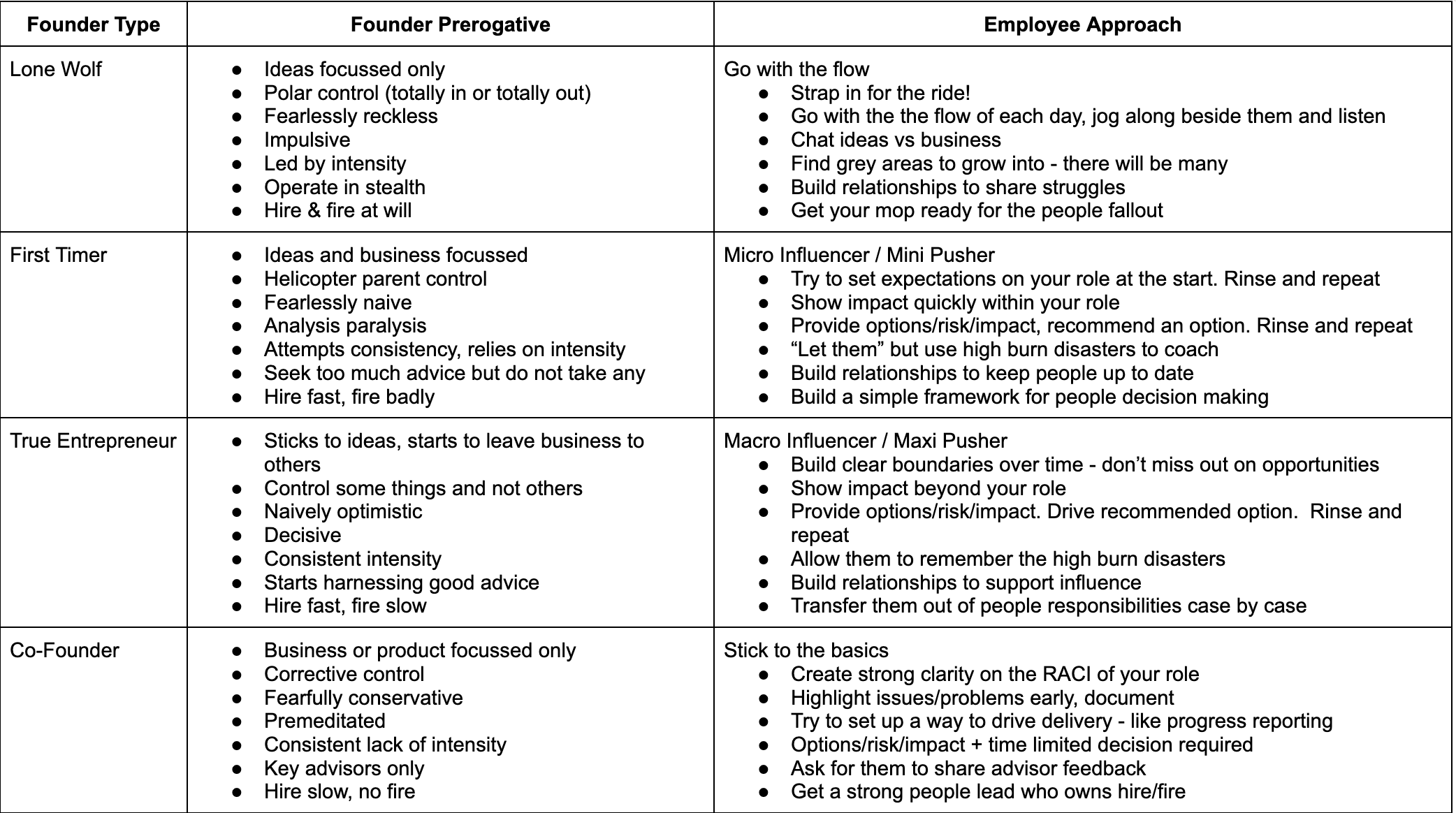
Looking back, I’m grateful to the Lone Wolves, First Timers, True Entrepreneurs and Co-Founders who gave me opportunities. I was handed significant responsibility and gained invaluable experience.
Yes, a few founders probably cursed the day they hired me (I’ve been called pushy, bolshy, a ball-breaker—my personal favourite: “bad bitch”). Reminder: you’re also irritating, just in different ways to them. But the gift of learning how to get an idea off the ground and being part of building something? It’s a privilege that I’ll never take lightly.
XX BB
Big thanks for reading my Substack! I’d love this to be an interactive group of hardened startup people sharing their stories and advice on what it really takes to build. Please share this with people you know will either laugh or cry at this post due to their #startuplife.
PS - All the disturbing images, fake english and melted faces were created using ChatGPT (which I now pay for)!